Welcome to The Source
Welcome to The Source! Our new online space for knowledge, information-sharing and OD news.
The purpose of this site is to help us connect better across teams and people within OD, and to provide a source of truth for some of the information that can help us work better together.
We know our people have a lot of knowledge to share, and it's here that you can do that. So please, share what you know and discover - the sort of things that are interesting, useful and helpful. You can also post questions and ask for help from other people in OD.
Have a look around the site and let us know if you have any questions.
Please check out our community guidelines that support positive participation and collaboration on the site.
Welcome to The Source! Our new online space for knowledge, information-sharing and OD news.
The purpose of this site is to help us connect better across teams and people within OD, and to provide a source of truth for some of the information that can help us work better together.
We know our people have a lot of knowledge to share, and it's here that you can do that. So please, share what you know and discover - the sort of things that are interesting, useful and helpful. You can also post questions and ask for help from other people in OD.
Have a look around the site and let us know if you have any questions.
Please check out our community guidelines that support positive participation and collaboration on the site.
Tell your story
You cannot leave comment in the story unless you are a part of the project panel.
-
High-Performing Teams Need Psychological Safety. Here’s How to Create It
by Sarah Rose, over 8 years agoGreat article from Harvard Business Review on how psychological safety can build high performing teams and what we can all do to help.
High-Performing Teams Need Psychological Safety. Here’s How to Create It
“There’s no team without trust,” says Paul Santagata, Head of Industry at Google. He knows the results of the tech giant’s massive two-year study on team performance, which revealed that the highest-performing teams have one thing in common: psychological safety, the belief that you won’t be punished when you make a mistake. Studies show that psychological safety allows for moderate risk-taking, speaking your mind, creativity... Continue reading
Great article from Harvard Business Review on how psychological safety can build high performing teams and what we can all do to help.
High-Performing Teams Need Psychological Safety. Here’s How to Create It
“There’s no team without trust,” says Paul Santagata, Head of Industry at Google. He knows the results of the tech giant’s massive two-year study on team performance, which revealed that the highest-performing teams have one thing in common: psychological safety, the belief that you won’t be punished when you make a mistake. Studies show that psychological safety allows for moderate risk-taking, speaking your mind, creativity, and sticking your neck out without fear of having it cut off — just the types of behavior that lead to market breakthroughs.
Ancient evolutionary adaptations explain why psychological safety is both fragile and vital to success in uncertain, interdependent environments. The brain processes a provocation by a boss, competitive coworker, or dismissive subordinate as a life-or-death threat. The amygdala, the alarm bell in the brain, ignites the fight-or-flight response, hijacking higher brain centers. This “act first, think later” brain structure shuts down perspective and analytical reasoning. Quite literally, just when we need it most, we lose our minds. While that fight-or-flight reaction may save us in life-or-death situations, it handicaps the strategic thinking needed in today’s workplace.
Twenty-first-century success depends on another system — the broaden-and-build mode of positive emotion, which allows us to solve complex problems and foster cooperative relationships. Barbara Fredrickson at the University of North Carolina has found that positive emotions like trust, curiosity, confidence, and inspiration broaden the mind and help us build psychological, social, and physical resources. We become more open-minded, resilient, motivated, and persistent when we feel safe. Humor increases, as does solution-finding and divergent thinking — the cognitive process underlying creativity.
When the workplace feels challenging but not threatening, teams can sustain the broaden-and-build mode. Oxytocin levels in our brains rise, eliciting trust and trust-making behavior. This is a huge factor in team success, as Santagata attests: “In Google’s fast-paced, highly demanding environment, our success hinges on the ability to take risks and be vulnerable in front of peers.”
So how can you increase psychological safety on your own team? Try replicating the steps that Santagata took with his:
1. Approach conflict as a collaborator, not an adversary. We humans hate losing even more than we love winning. A perceived loss triggers attempts to reestablish fairness through competition, criticism, or disengagement, which is a form of workplace-learned helplessness. Santagata knows that true success is a win-win outcome, so when conflicts come up, he avoids triggering a fight-or-flight reaction by asking, “How could we achieve a mutually desirable outcome?”
2. Speak human to human. Underlying every team’s who-did-what confrontation are universal needs such as respect, competence, social status, and autonomy. Recognizing these deeper needs naturally elicits trust and promotes positive language and behaviors. Santagata reminded his team that even in the most contentious negotiations, the other party is just like them and aims to walk away happy. He led them through a reflection called “Just Like Me,” which asks you to consider:
- This person has beliefs, perspectives, and opinions, just like me.
- This person has hopes, anxieties, and vulnerabilities, just like me.
- This person has friends, family, and perhaps children who love them, just like me.
- This person wants to feel respected, appreciated, and competent, just like me.
- This person wishes for peace, joy, and happiness, just like me.
3. Anticipate reactions and plan countermoves. “Thinking through in advance how your audience will react to your messaging helps ensure your content will be heard, versus your audience hearing an attack on their identity or ego,” explains Santagata.
Skillfully confront difficult conversations head-on by preparing for likely reactions. For example, you may need to gather concrete evidence to counter defensiveness when discussing hot-button issues. Santagata asks himself, “If I position my point in this manner, what are the possible objections, and how would I respond to those counterarguments?” He says, “Looking at the discussion from this third-party perspective exposes weaknesses in my positions and encourages me to rethink my argument.”
Specifically, he asks:
- What are my main points?
- What are three ways my listeners are likely to respond?
- How will I respond to each of those scenarios?
4. Replace blame with curiosity. If team members sense that you’re trying to blame them for something, you become their saber-toothed tiger. John Gottman’s research at the University of Washington shows that blame and criticism reliably escalate conflict, leading to defensiveness and — eventually — to disengagement. The alternative to blame is curiosity. If you believe you already know what the other person is thinking, then you’re not ready to have a conversation. Instead, adopt a learning mindset, knowing you don’t have all the facts. Here’s how:
- State the problematic behavior or outcome as an observation, and use factual, neutral language. For example, “In the past two months there’s been a noticeable drop in your participation during meetings and progress appears to be slowing on your project.”
- Engage them in an exploration. For example, “I imagine there are multiple factors at play. Perhaps we could uncover what they are together?”
- Ask for solutions. The people who are responsible for creating a problem often hold the keys to solving it. That’s why a positive outcome typically depends on their input and buy-in. Ask directly, “What do you think needs to happen here?” Or, “What would be your ideal scenario?” Another question leading to solutions is: “How could I support you?”
5. Ask for feedback on delivery. Asking for feedback on how you delivered your message disarms your opponent, illuminates blind spots in communication skills, and models fallibility, which increases trust in leaders. Santagata closes difficult conversations with these questions:
- What worked and what didn’t work in my delivery?
- How did it feel to hear this message?
- How could I have presented it more effectively?
For example, Santagata asked about his delivery after giving his senior manager tough feedback. His manager replied, “This could have felt like a punch in the stomach, but you presented reasonable evidence and that made me want to hear more. You were also eager to discuss the challenges I had, which led to solutions.”
6. Measure psychological safety. Santagata periodically asks his team how safe they feel and what could enhance their feeling of safety. In addition, his team routinely takes surveys on psychological safety and other team dynamics. Some teams at Google include questions such as, “How confident are you that you won’t receive retaliation or criticism if you admit an error or make a mistake?”
If you create this sense of psychological safety on your own team starting now, you can expect to see higher levels of engagement, increased motivation to tackle difficult problems, more learning and development opportunities, and better performance.
-
We know too much sitting is bad for our waists — but is it bad for our brains, too?
by Jennifer Lee, over 8 years agoIn many aspects of life where we need to use our brain power, we also tend to sit down: at school, at work, sitting exams or concentrating on a crossword.
In a new paper, we explore how prolonged sitting may affect the brain's fuel supply and have a negative impact on brain health.
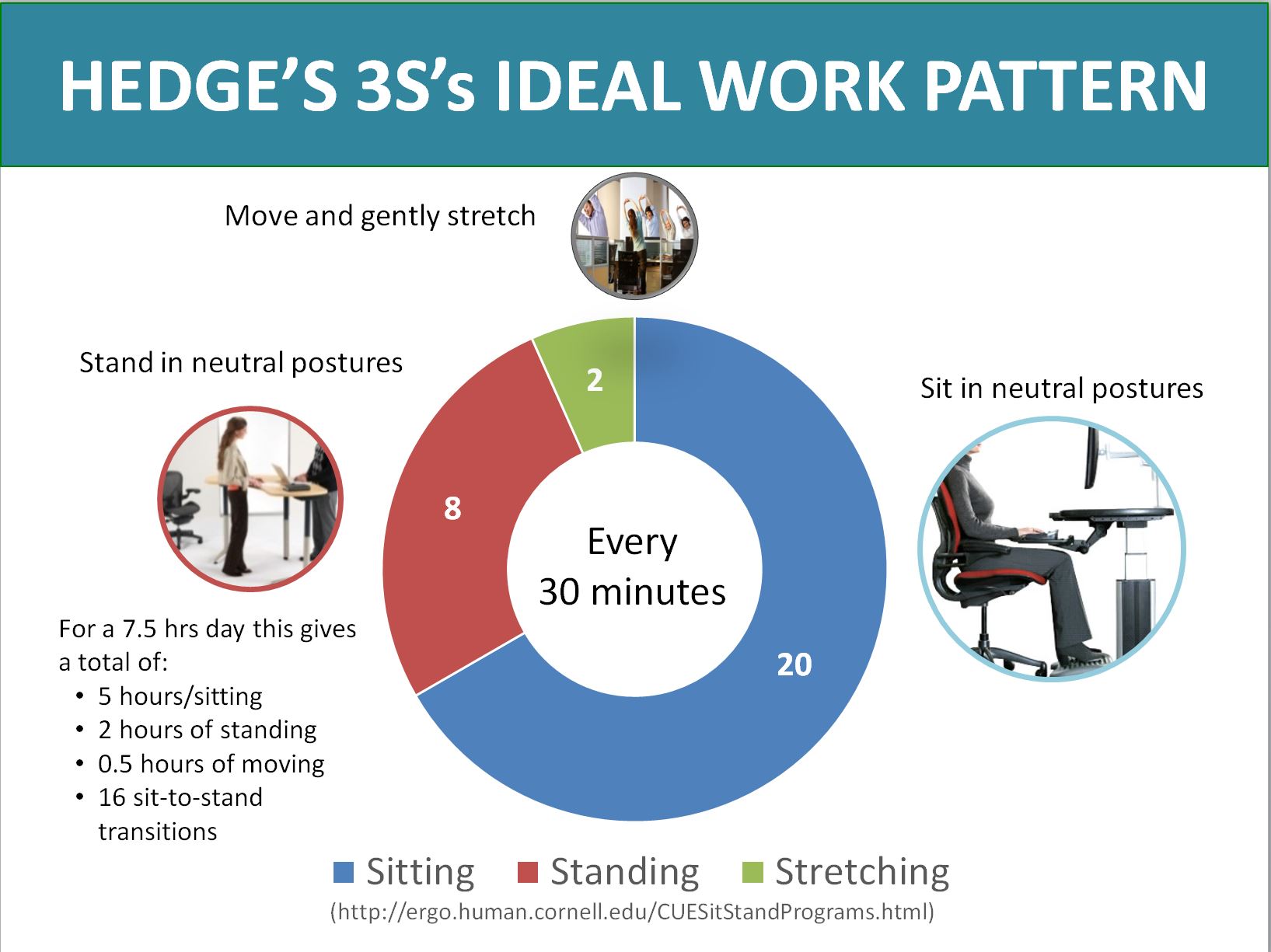
http://www.abc.net.au/news/2017-07-28/can-too-much-time-sitting-affect-our-brain-function-conversation/8753612Prof Alan Hedge, a leading researcher in the area, suggests a good pattern of sitting/ standing/moving is breaking time into 30 minute blocks and sitting for 20, standing for 8 and moving for 2.
In many aspects of life where we need to use our brain power, we also tend to sit down: at school, at work, sitting exams or concentrating on a crossword.
In a new paper, we explore how prolonged sitting may affect the brain's fuel supply and have a negative impact on brain health.
http://www.abc.net.au/news/2017-07-28/can-too-much-time-sitting-affect-our-brain-function-conversation/8753612Prof Alan Hedge, a leading researcher in the area, suggests a good pattern of sitting/ standing/moving is breaking time into 30 minute blocks and sitting for 20, standing for 8 and moving for 2.
-
Are you confused about agile methodology? Here's a short 2 min video....
by Sarah Rose, over 8 years agoIn less than two minutes this video from stickystories simplifies and explains some key concepts of Agile methodology through the lens of a project owner.Compared to a traditional approach, agile provides benefits of delivering increased value in shorter timeframes based on critical outcomes.
How do you think could we use this in an government OD context?
https://www.stickystories.co/whats-different-for-business-stakeholders-when-its-an-agile-approach/
#Agile
In less than two minutes this video from stickystories simplifies and explains some key concepts of Agile methodology through the lens of a project owner.Compared to a traditional approach, agile provides benefits of delivering increased value in shorter timeframes based on critical outcomes.
How do you think could we use this in an government OD context?
https://www.stickystories.co/whats-different-for-business-stakeholders-when-its-an-agile-approach/
#Agile
-
Could a robot do your job?
by Georgia, over 8 years agoNew data from research house AlphaBeta provides the answer.
Search to find your job — if you’re game.
http://www.abc.net.au/news/2017-08-08/could-a-robot-do-your-job-artificial-intelligence/8782174
New data from research house AlphaBeta provides the answer.
Search to find your job — if you’re game.
http://www.abc.net.au/news/2017-08-08/could-a-robot-do-your-job-artificial-intelligence/8782174
-
Justine Parbery Profile
by Georgia, over 8 years ago
Justine Parbery has been with Transport for 8 years. After graduating with a degree in food science she was looking for something as far from nutrition as she could get and landed in a trainee signaller role with RailCorp. From there she has moved through various roles in different agencies and is now a permanent personality within the Diversity & Inclusion (D&I) team. Justine’s primary role, and one she does exceptionally well, is heading up the Women In Leadership (WiL) Program which aims to create awareness of gender equality within Transport and increase the representation of female senior leaders to ... Continue reading
Justine Parbery has been with Transport for 8 years. After graduating with a degree in food science she was looking for something as far from nutrition as she could get and landed in a trainee signaller role with RailCorp. From there she has moved through various roles in different agencies and is now a permanent personality within the Diversity & Inclusion (D&I) team. Justine’s primary role, and one she does exceptionally well, is heading up the Women In Leadership (WiL) Program which aims to create awareness of gender equality within Transport and increase the representation of female senior leaders to 25.5% by December 2017. At the moment she is working on a range of projects including the WiL intranet site (http://www.stayinformed.com.au/women-in-leadership) and the Connecting Forum. If you want more information about the Women in Leadership program of work, Justine is your gal!
While the D&I team knows Justine well, we thought this was a great opportunity for everyone else to get the know the person we all know and love working with…
1. What gets you fired up?
I love a good challenge, particularly when someone says it can’t be done
2. What do you say more often in life: yes or no?
No, which is strange given my response to question 1?
3. What would you tell your teenage self if you could go back in time?
Do what you love and not what people think you should do
4. What chance encounter changed your life forever?
Meeting my husband, my life will never be the same again
5. What is one thing you're glad you tried but would never do again?
Bungee jumping, who knew you could do tandem in Bali?
6. Who's your go-to band or artist when you can't decide on something to listen to?
Perhaps Bruno Mars, though depends on my mood
7. Where is the most interesting place you've been?
Scuba diving in Koh Tao
8. If you had to change your name, what would your new name be, and why would you choose that name?
Not sure on the name, but would give anything for people to stop calling me Justin
9. What’s the closest thing to real magic?
Apart from magic... Disney Land
10. What’s something your brain tries to make you do and you have to will yourself not to do it?
Over thinking, this is why I’m probably prone to saying ‘no’
-
Profile of Vanessa D'Souza
by OD Great Place to Work, over 8 years agoTell us a bit about your work history, how did you get here?My career started in India as a HR Management Trainee (Graduate) at a Marriott Group resort and then with a German pharmaceutical firm. I moved to Australia in 2006 and worked at the Australian Catholic University before starting my Transport journey with RailCorp in HR Policy, then moved to TfNSW and am now in the Leadership and Corporate team within OD.What’s one tip about working here that has helped you be successful?The one tip that I have learnt working in government... Continue readingTell us a bit about your work history, how did you get here?My career started in India as a HR Management Trainee (Graduate) at a Marriott Group resort and then with a German pharmaceutical firm. I moved to Australia in 2006 and worked at the Australian Catholic University before starting my Transport journey with RailCorp in HR Policy, then moved to TfNSW and am now in the Leadership and Corporate team within OD.What’s one tip about working here that has helped you be successful?The one tip that I have learnt working in government is not to allow the bureaucracy to dampen my spirit. I look around and see wonderful people working all around me doing their very best to deliver against all odds and this keep me going everyday.What are you passionate about?I am passionate about my dessert ......seriously...I could give up lunch or dinner if I knew that I had a great dessert afterWhat would you tell your teenage self if you could go back in time?I would tell my teenage self to be bold and experiment, to take risks and not be afraid to fail.What have you created that you’re most proud of?My kids (Rishaan 9 yrs and Roneil 3.5yrs)#PeopleProfiles -
What Elon Musk, Richard Branson and 8 other successful people ask job candidates..
by Amanda Shaw, over 8 years agoIt is great to see people getting away from the standard "where do you see yourself in 5 years" question..
It is great to see people getting away from the standard "where do you see yourself in 5 years" question..
-
4 brilliant things leaders do that earn respect
by Sarah Rose, over 8 years ago
Interesting article of 4 traits that leaders (and all of us) can do to gain respect in the workplace.https://www.inc.com/marcel-schwantes/4-rare-and-brilliant-things-smart-leaders-do-to-ge.html
-
Back to the Future - In 20 Years
by Sebastian Csikos, over 8 years agoHave a look what the CEO of 17 Minutes Languages has to say about the future in 20 years. I personally love it and I think the future is almost here.
What do you think?
https://www.linkedin.com/pulse/must-read-article-how-our-lives-change-dramatically-20-delahunty
Have a look what the CEO of 17 Minutes Languages has to say about the future in 20 years. I personally love it and I think the future is almost here.
What do you think?
https://www.linkedin.com/pulse/must-read-article-how-our-lives-change-dramatically-20-delahunty
-
Interesting questions asked when looking at the Driverless Car
by Sarah Rose, over 8 years ago
I had never even thought of these social implications when it come to driverless cars! What are your thoughts?
http://www.innovationmanagement.se/2012/10/03/driverless-vehicles-more-than-a-technology-issue/
I had never even thought of these social implications when it come to driverless cars! What are your thoughts?
http://www.innovationmanagement.se/2012/10/03/driverless-vehicles-more-than-a-technology-issue/